
Cryptocurrency is a digital asset, most often based on blockchain technology.
Cryptocurrency is a digital or virtual form of money that uses cryptography for security. Unlike traditional government-issued currencies, cryptocurrencies operate on decentralized networks utilizing blockchain technology. A blockchain is a distributed ledger that records all transactions across numerous computers, ensuring security and transparency.
A defining feature of cryptocurrencies is that they are generally not issued by any central authority, rendering them theoretically resistant to government interference or manipulation.
Types of Cryptocurrency
Cryptocurrencies come in various forms, each serving a different purpose. Here’s a breakdown of the most common types:
- 1. Transactional Tokens: These tokens are designed for use as a payment method, making them the most straightforward form of cryptocurrency. Bitcoin (BTC) is the most well-known transactional token. It is used to transfer value between users.
- 2. Utility Tokens: Utility tokens are used within a specific blockchain or platform to enable certain functions. Ethereum (ETH) and XRP (Ripple) are examples of utility tokens. For instance, ETH is used to pay for computational services and transaction fees on the Ethereum network.
- 3. Governance Tokens: These tokens give holders the power to participate in decision-making processes within a blockchain. Holders can vote on proposals that affect the protocol. An example is Uniswap (UNI), which allows users to vote on key decisions about the decentralized exchange.
- 4. Platform Tokens: Platform tokens support decentralized applications (dApps) built on their respective blockchains. Solana (SOL) is an example, offering a platform for developers to create high-speed, scalable applications.
- 5. Security Tokens: Security tokens represent ownership in real-world assets, such as stocks or bonds. These tokens are regulated by financial authorities and are designed to provide a secure way to digitize and trade assets on the blockchain.
- 6. Memecoins: Memecoins have gained significant popularity, often created as jokes or for community fun. Dogecoin (DOGE) is a prime example. Although initially intended as a meme, it has developed a large following and is actively traded.
What Can You Do with Cryptocurrency?
Cryptocurrency has become much more than just a form of digital money. It opens up a wide range of possibilities beyond simply sending and receiving funds. From investing and making purchases to earning rewards and participating in innovative technologies, cryptocurrencies offer exciting opportunities. Below, we’ll explore some of the key things you can do with cryptocurrency today.
- Send and Receive Payments: Cryptocurrencies allow for fast and low-cost transactions across the globe without needing intermediaries like banks. This makes international transfers easier and cheaper.
- Invest and Trade: Many people buy cryptocurrencies as an investment, hoping their value will increase over time. You can trade them on cryptocurrency exchanges or hold them as a long-term asset.
- Make Purchases: Some businesses accept cryptocurrency as a form of payment for goods and services. You can use crypto to buy anything from products online to paying for services in certain areas.
- Earn Interest or Rewards: Some cryptocurrencies offer staking or lending programs, allowing you to earn rewards or interest by holding and locking up your crypto in specific platforms.
- Participate in Decentralized Finance (DeFi): DeFi platforms allow users to engage in traditional financial services—like lending, borrowing, and trading—without relying on traditional banks or financial institutions.
- Access Decentralized Apps (dApps): Some cryptocurrencies like Ethereum enable users to access decentralized applications (dApps) built on blockchain platforms. These apps can range from games to finance management tools.
- Create Smart Contracts: With certain cryptocurrencies, you can create and execute smart contracts—automated agreements that self-execute when specific conditions are met, without the need for a middleman.
- Donate to Charities: Cryptocurrencies can be used for donations to causes or charities that accept them, often providing more privacy and lower fees than traditional methods.
- Tokenize Real-World Assets: Some cryptocurrencies, like security tokens, represent ownership of real-world assets (e.g., real estate, stocks), enabling digital trading of physical assets.
- Mine New Cryptocurrency: If you have the necessary hardware and resources, you can participate in mining—using computational power to solve complex problems and earn cryptocurrency rewards.
Advantages and Disadvantages of Cryptocurrency
Cryptocurrencies were introduced with the goal of revolutionizing the financial system. However, like any major change, there are tradeoffs. At this stage of development, there is often a gap between the ideal concept of a fully decentralized system and the practical reality of how cryptocurrencies are being used.
| Advantages | Disadvantages |
|---|---|
| Decentralization: Removes single points of failure and ensures network resilience. | Pseudonymity: Transactions are not fully anonymous, potentially exposing user activity. |
| Removes Third Parties: Eliminates intermediaries like banks, reducing costs and delays. | Criminal Uses: Pseudonymity can facilitate illegal activities like money laundering. |
| Easier Fund Transfers: Enables quick, secure, and low-cost transactions between parties. | Centralization Risks: Despite claims of decentralization, mining and development can become concentrated. |
| Can Generate Returns: Cryptocurrencies can be invested or staked to earn rewards. | Expensive Participation: Mining and network participation require significant resources and technical knowledge. |
| Streamlined Remittances: Offers efficient cross-border payment solutions. | Off-Chain Security Issues: Wallets and exchanges are vulnerable to hacking and theft. |
| Transparency: Blockchain technology provides publicly verifiable transaction records. | Regulatory Uncertainty: Changing regulations can impact legality and usability. |
| Lower Transaction Costs: Reduces fees compared to traditional financial systems. | Environmental Concerns: Mining-based cryptocurrencies consume vast amounts of energy. |
How Does Cryptocurrency Work?
Cryptocurrency operates using a combination of technologies and principles that differentiate it from traditional money. To understand how it works, let’s break down its key components, how transactions are made, and the systems that keep it secure and functional.
The Technology Behind Cryptocurrency
At the core of every cryptocurrency is blockchain technology. A blockchain is like a digital ledger that records all transactions made with a particular cryptocurrency. Unlike a traditional ledger maintained by a bank, a blockchain is spread across many computers, called nodes, ensuring that no single person or organization controls it.
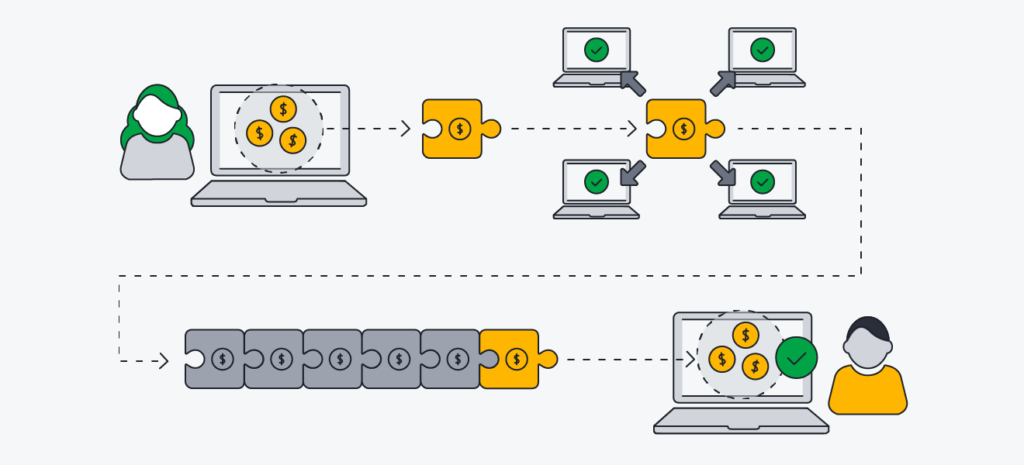
Each transaction is grouped with others into a “block.” Once a block is full, it is added to the chain in the order it was created. This makes the blockchain secure because changing any single transaction would require altering all the following blocks, which is extremely difficult to do.
Making Transactions with Cryptocurrency
Using cryptocurrency involves sending and receiving funds through digital wallets. A digital wallet is similar to a bank account but for digital money. Each wallet has a unique address that you can share with others to receive cryptocurrency.
When you want to send cryptocurrency:
- Initiate the Transaction: Enter the recipient’s wallet address and the amount you want to send.
- Verification: The transaction is sent to the network, where nodes check it to ensure it’s valid.
- Adding to the Blockchain: Once verified, the transaction is added to a new block on the blockchain.
- Completion: The recipient receives the funds in their wallet almost instantly.
This process ensures that transactions are secure and transparent, as everyone can see the transactions on the blockchain.
Mining and Consensus Mechanisms
To keep the blockchain secure and to add new transactions, cryptocurrencies use a process called mining along with different methods to agree on the state of the blockchain, known as consensus mechanisms.
- Mining: Miners use powerful computers to solve complex puzzles that verify transactions. When miners solve a puzzle, they add a new block to the blockchain and earn some cryptocurrency as a reward.
- Proof of Work (PoW): This is the original method Bitcoin used. Miners compete to solve puzzles, and the first to solve them gets to add the block and receive the reward. While effective, PoW requires a lot of energy.
- Proof of Stake (PoS): Instead of mining, validators are chosen to add new blocks based on how many coins they hold and are willing to “stake” as a guarantee. PoS uses less energy and is becoming more popular as an alternative to PoW.
These methods ensure the blockchain remains secure and all transactions are correctly verified.
Transaction Fees and Incentives for Miners
When you send cryptocurrency, you usually pay a small fee. These fees serve two primary purposes: they compensate miners for processing your transaction and help maintain the network.
- Transaction Fees: The amount you pay can vary based on the cryptocurrency and how busy the network is. Higher fees can speed up your transaction during busy times.
- Incentives for Miners: Miners earn these fees along with rewards in cryptocurrency for their work in verifying and adding transactions to the blockchain. This motivates them to keep the network secure and running smoothly.
Security Measures in Cryptocurrency
Security is a fundamental aspect of cryptocurrency, ensuring that your digital money remains safe.
- Cryptography: Cryptocurrencies use advanced codes to secure transactions and control the creation of new units. This makes it nearly impossible for unauthorized people to access or alter your funds.
- Immutable Ledger: Once a transaction is added to the blockchain, it cannot be changed or deleted. This protects against fraud and ensures that all transaction records are accurate and trustworthy.
- Network Security: Because the blockchain is decentralized and spread across many computers, it is very difficult for hackers to attack the entire system. There is no single point of failure, making the network more robust and secure.
Getting Started with Cryptocurrency
If you’re new to the world of cryptocurrency, it might seem overwhelming at first. However, getting started is easier than ever, especially with the growing number of exchanges and in-wallet purchasing options. Below, we break down how to begin your journey into cryptocurrency.
Cryptocurrency Wallets and Storage
Keeping your cryptocurrency safe is crucial. This is done using different types of wallets, each offering different levels of security and convenience.
- Hot Wallets: These wallets are connected to the internet and are convenient for everyday use. Examples include mobile apps and online wallets. However, they are more vulnerable to hacking.
- Cold Wallets: These are offline wallets, such as hardware devices or paper wallets, that provide better security by keeping your private keys offline. Cold wallets are ideal for storing more significant amounts of cryptocurrency for longer periods.
Best Practices for Securing Your Wallet
Ensuring the security of your cryptocurrency wallet involves several important practices:
- Use Strong Passwords: Create complex and unique passwords for your wallets to prevent unauthorized access.
- Enable Two-Factor Authentication (2FA): Adding an extra layer of security makes it harder for attackers to breach your wallet.
- Backup Your Wallet: Keep secure backups of your wallet’s private keys or seed phrases in multiple safe locations. This ensures you can recover your funds if you lose access to your wallet.
- Stay Updated: Regularly update your wallet software to protect against the latest security vulnerabilities.
Common Wallet Mistakes to Avoid
Avoid these common mistakes to keep your cryptocurrency safe:
- Sharing Private Keys: Never share your private keys or seed phrases with anyone. These are the keys to your funds.
- Using Weak Passwords: Avoid simple or easily guessable passwords. Use a combination of letters, numbers, and symbols.
- Ignoring Security Alerts: Pay attention to security warnings from your wallet provider and take necessary actions promptly.
- Storing Large Amounts in Hot Wallets: Keep only the amount you need for daily transactions in hot wallets. Store the rest in cold wallets for better security.
Cryptocurrency Exchanges: Buying and Trading Crypto
Cryptocurrency exchanges are platforms where you can buy, sell, and trade digital currencies. Many exchanges allow you to exchange traditional currencies (like USD or EUR) for cryptocurrencies such as Bitcoin or Ethereum.
- Centralized Exchanges (CEX): These exchanges are operated by companies that manage the trading platform. Examples include Binance, Coinbase, and Kraken. They offer a range of services, from spot trading to derivatives. However, users do not control their private keys on these platforms, meaning their funds are stored in the exchange’s wallets.
- Decentralized Exchanges (DEX): These exchanges allow users to trade cryptocurrencies directly with each other without the need for an intermediary. Examples include Uniswap and SushiSwap. DEXs usually offer more privacy and control over your funds but may have higher fees and less user support.
Storing Your Cryptocurrency on Exchanges
When you store your cryptocurrency on an exchange, it is held in the exchange’s own wallets, meaning you don’t control the private keys. This introduces some security risks, including the potential for hacking or platform failure. However, exchanges often offer features like staking, lending, and liquidity pools, which can be attractive for some users.
To mitigate risks, it’s advised to:
- Use Two-Factor Authentication (2FA): For added security, enable 2FA on your exchange account to reduce the likelihood of unauthorized access.
- Withdraw Funds to Personal Wallets: For long-term holding, it’s generally recommended to transfer your funds to a private wallet (hot or cold) rather than leaving them on an exchange.
The Bottom Line
Cryptocurrency is revolutionizing the financial landscape by offering a decentralized, secure, and transparent alternative to traditional money. While it opens up new opportunities for payment, investment, and innovation, it also comes with risks, such as security vulnerabilities and regulatory uncertainty. Understanding how cryptocurrencies work, their types and their uses can help you navigate this evolving space. However, staying informed and exercising caution when investing or using cryptocurrency is important.
This article is exactly what I needed! Your insights are incredibly helpful.
I’m happy to hear you find value in my content. Thanks for your continued support!
You’ve changed the way I think about this topic. I appreciate your unique perspective.